Every growing organization reaches a point where information becomes hard to manage. Policies live in PDFs. SOPs are buried in folders. Important instructions are passed verbally or remembered by experience. New team members ask the same questions again and again. Support teams waste time searching. Decisions are made based on memory instead of documentation. ProofIQ was built to solve this exact problem—turning static documents into a living knowledge system that teams can actually trust.
Related service: AI & LLM Integration Services
The problem: information exists, but it's not accessible
I saw this problem repeatedly while working with teams that relied heavily on internal documents. They didn't lack information—they lacked access to the right information at the right time. Critical knowledge was scattered across file systems, email threads, and team members' memories.
The consequences were clear: new hires took weeks to ramp up, support teams spent hours searching for answers, and decisions were made based on incomplete information. The gap between having documentation and actually using it was massive.
- Policies and SOPs buried in folders, rarely accessed
- Important instructions passed verbally or remembered by experience
- New team members asking the same questions repeatedly
- Support teams wasting time searching through documents
- Decisions made from memory instead of documented truth
The problem wasn't a lack of information—it was a lack of access. Teams had the documents, but they couldn't find what they needed when they needed it.
The idea: what if knowledge worked for you?
The goal was simple: what if teams could ask questions in plain language and get clear, accurate answers directly from their own documents—without guessing, hallucinations, or security risks?
Most AI tools search the internet or generate answers without showing where the information comes from. That doesn't work for real businesses where accuracy and trust matter. ProofIQ was designed to do one thing exceptionally well: answer questions only from your organization's documents, and show exactly where the answer came from.
How ProofIQ works: simplicity on the surface, intelligence underneath
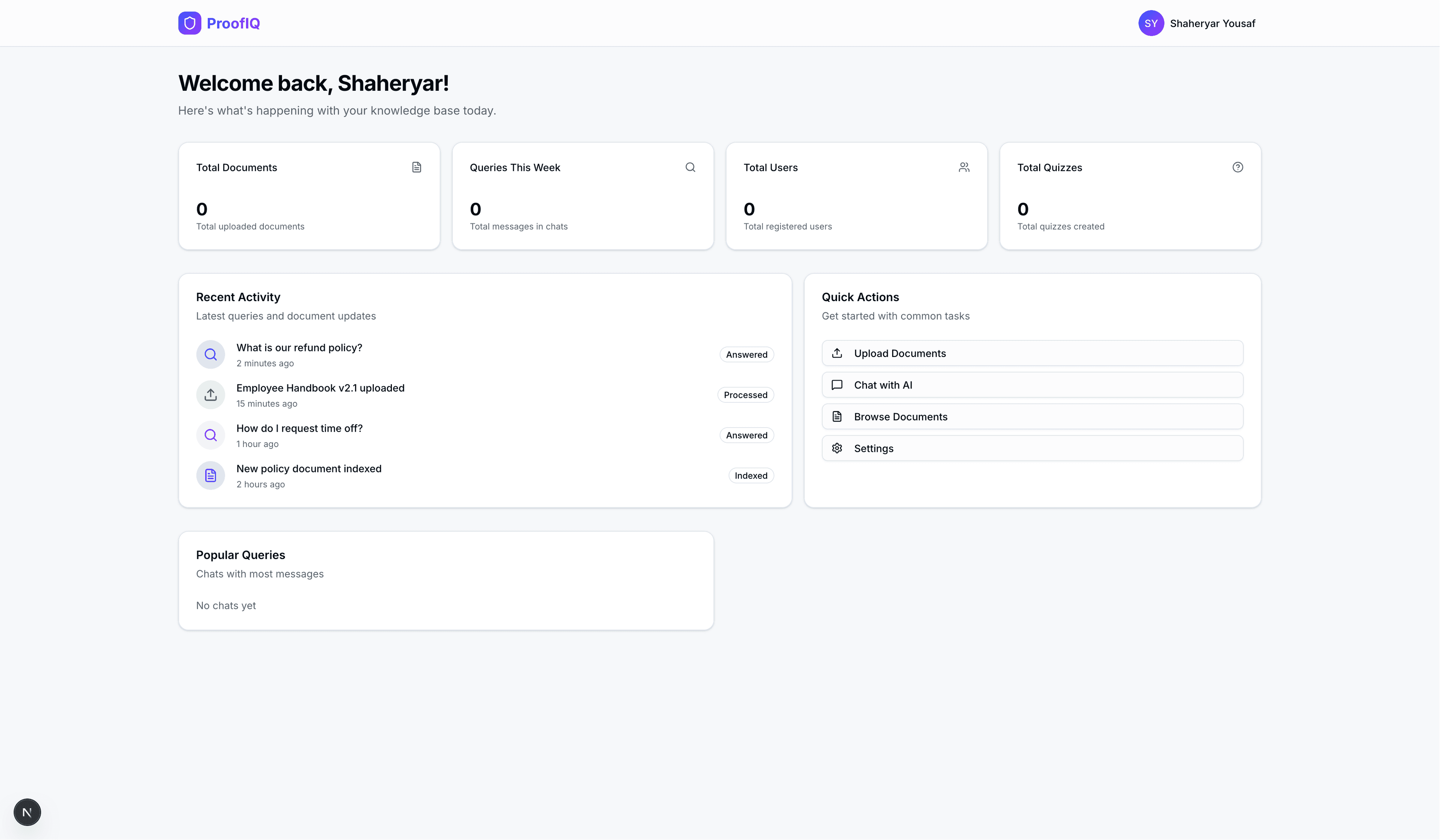
From a user's perspective, ProofIQ feels simple. Documents are uploaded once, the system organizes and indexes the information, and team members can ask questions in natural language.
The complexity stays behind the scenes. The experience stays clean and intuitive. Users don't need to understand vector embeddings, retrieval strategies, or prompt engineering—they just ask questions and get answers.
- Upload internal documents: policies, SOPs, manuals, guides, and more
- Ask questions in natural language: 'What is our leave policy?' or 'How do we handle client onboarding?'
- Receive clear answers backed by exact source references from your documents
- Trust the results: if information doesn't exist in your documents, ProofIQ doesn't invent it
Key problems ProofIQ solves
ProofIQ addresses the fundamental challenges that prevent organizations from effectively using their own knowledge. It replaces searching, guessing, and asking around with one reliable source of truth.
- Scattered knowledge across files and folders
- Repeated questions that slow teams down
- Long onboarding times for new hires
- Support and operations bottlenecks
- Lack of trust in AI-generated answers
Why ProofIQ is different: built for real business use
ProofIQ was intentionally built with real business use in mind. Unlike generic AI assistants that pull from the internet or generate creative responses, ProofIQ operates within strict boundaries that make it suitable for companies dealing with sensitive or operationally critical information.
- Only uses uploaded internal documents—no internet search, no external data
- Provides source-backed answers with exact document references
- Respects privacy and access control
- Avoids hallucinations by design—if it's not in your documents, it won't make it up
- Designed for accuracy and trust, not creativity
If the answer can't be trusted, it shouldn't be shown. Every design decision in ProofIQ was guided by this principle.
My role: end-to-end design and development
I designed and built ProofIQ from concept to completion. This included architecting the system, building the document ingestion pipeline, implementing the question-answering logic with source grounding, and creating a user experience focused on clarity and trust.
The technical challenge wasn't just building a RAG system—it was building one that users could trust. That meant implementing error handling to avoid false or misleading responses, designing clear source attribution, and creating an interface that made the system's limitations transparent.
- Product concept and system architecture
- Document ingestion and indexing pipeline
- Question-answering logic with source grounding
- User experience focused on clarity and trust
- Error handling to avoid false or misleading responses
The impact: from hunting for information to having it work for you
ProofIQ transforms information from something people hunt for into something that works for them. Teams spend less time searching. New hires ramp up faster. Support teams answer questions with confidence. Decisions are based on documented truth, not memory.
The system doesn't just store documents—it makes them useful. It turns static PDFs and manuals into an interactive knowledge base that responds to questions in real-time.
- Reduced time spent searching for information
- Faster onboarding for new team members
- More confident support responses with source-backed answers
- Decisions based on documented truth instead of memory
- Transformed static documents into a living knowledge system
Final takeaway
ProofIQ represents the kind of products I enjoy building most: practical, trustworthy, built for real workflows, and designed to reduce friction, not add complexity. It's not about flashy AI features—it's about making knowledge usable. When teams can access their organization's knowledge instantly and trust the answers they receive, they can focus on what matters: building, solving, and moving forward.
Want a similar build?
If you're in a trade business and need software that matches your workflow end-to-end, let's talk.
Get In Touch