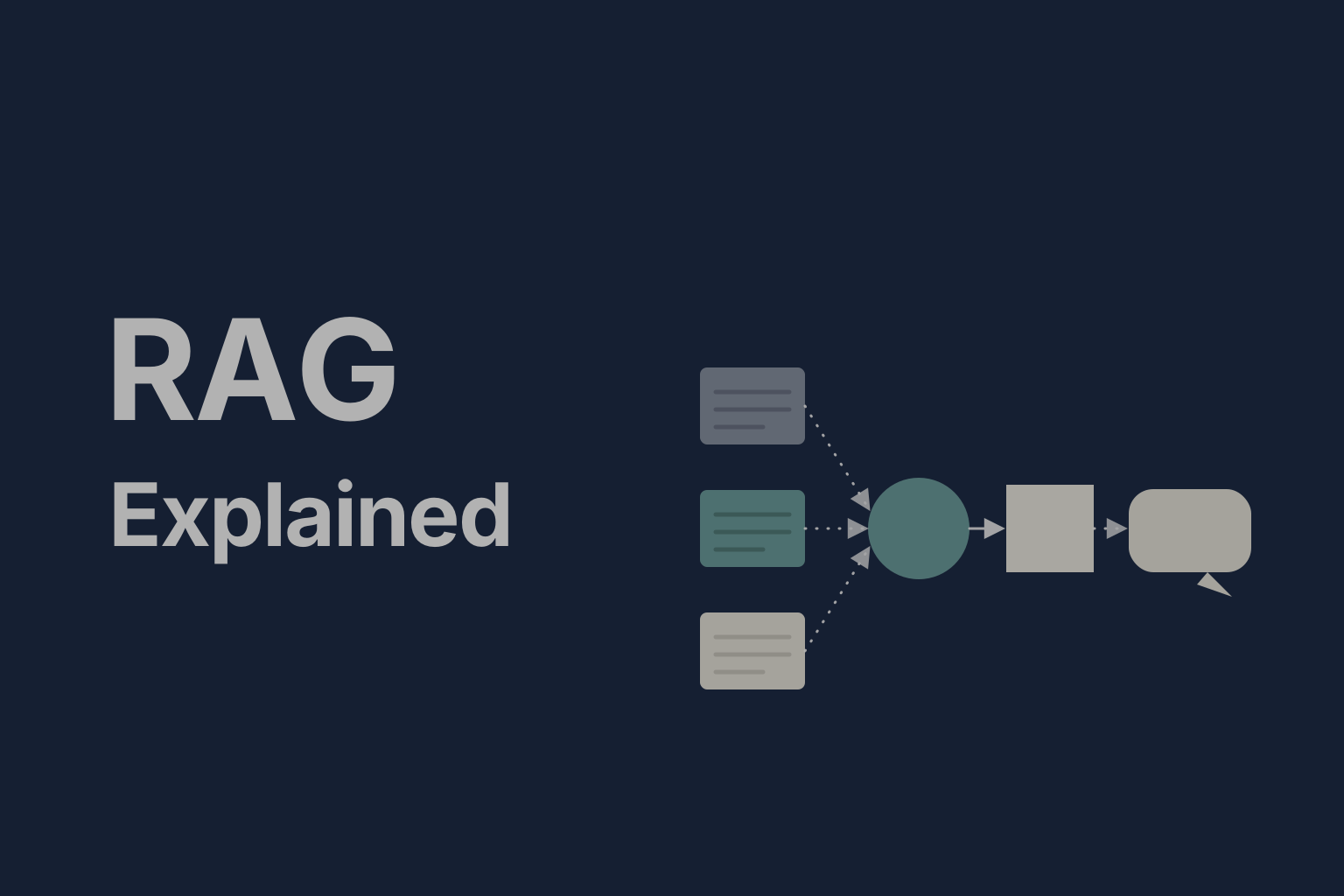
Every business has knowledge trapped in documents: product manuals, support tickets, internal wikis, policy files, past proposals. Employees search for it daily, customers ask about it constantly, and a surprising amount of time goes into finding answers that already exist somewhere in the company. RAG, short for retrieval-augmented generation, is the technique that connects that trapped knowledge to an AI assistant. Instead of hoping a language model happens to know your business, RAG gives it your documents to read before it answers. This article explains what RAG actually is, how it works step by step, what it costs, and when it makes sense for your business.
The Problem RAG Solves
Language models are trained on public internet text. They know a lot about the world in general and almost nothing about your business in particular. They do not know your product catalog, your pricing, your internal processes, or what your support team told a customer last Tuesday.
You have two bad options without RAG. Option one: let the model guess, which produces confident hallucinations about your own business. Option two: retrain or fine-tune the model on your data, which is expensive, slow to update, and overkill for most use cases. RAG is the third option: keep the general model, but hand it the right documents at the moment it answers.
RAG does not teach the model your business. It lets the model look things up, the way a good employee would.
What RAG Actually Is
Retrieval-augmented generation combines two systems that are each simple on their own. Retrieval finds the most relevant pieces of your content for a given question. Generation uses a language model to turn those pieces into a natural answer.
The name describes the pipeline exactly. The system retrieves relevant documents, then augments the model's prompt with them, then generates the answer. Nothing about your data is baked into the model itself, which means your knowledge stays current, private, and under your control.
How RAG Works, Step by Step
A production RAG system has five stages. Understanding each one helps you evaluate vendors, estimate costs, and know where things go wrong.
1. Your Documents Become Searchable Chunks
Everything starts with your source material: PDFs, web pages, help center articles, spreadsheets, chat transcripts. These are split into chunks, usually a few hundred words each, because a language model cannot read your entire company drive in one go, and because precise retrieval works better on focused passages than on whole documents.
Chunking strategy matters more than most people expect. Split in the wrong places and the retriever returns fragments that confuse the model. Tables, lists, and Q&A pairs each need slightly different handling. This is unglamorous work, and it determines the quality ceiling of the whole system.
2. Chunks Become Embeddings
Each chunk is converted into an embedding: a long list of numbers that captures the meaning of the text. Texts with similar meanings get similar numbers. This is what allows the system to match a customer's question to the right document even when they use completely different words.
Embeddings are computed once and stored. When your documents change, only the changed chunks need reprocessing, which keeps updates cheap and fast compared to retraining a model.
3. The Vector Database
Embeddings live in a vector database, a specialized store built for similarity search. When a question arrives, the database returns the chunks whose meanings are closest to the question, typically in milliseconds even across millions of chunks.
For most business applications this is a managed service or a lightweight library, not a major infrastructure project. The choice of vector store matters less than the quality of what you put into it.
4. Retrieval at Query Time
When a user asks a question, the system converts the question into an embedding, searches the vector database, and pulls back the top handful of relevant chunks. Good systems also rerank these results, filter by permissions so users only see documents they are allowed to see, and attach source references.
Permission filtering deserves emphasis. In a business setting, not every employee should see every document. Retrieval must respect the same access rules as the rest of your systems, or the assistant becomes a very efficient leak.
5. Grounded Answer Generation
Finally, the language model receives the question plus the retrieved chunks, with instructions to answer from those chunks and say so when the answer is not in them. The model does what it is good at: composing a clear, natural response. The chunks do what the model cannot: supplying facts about your business.
Because the answer is grounded in retrieved documents, it can include citations. Users can click through to the source, which builds trust and gives your team a way to verify and correct the knowledge base over time.
The model writes the answer. Your documents supply the facts. That separation is the whole idea.
What RAG Does Well
RAG is the right architecture for a wide range of business AI projects.
- Factual grounding: Answers come from your documents, which sharply reduces hallucinations about your business.
- Always current: Update a document and the assistant knows the new answer immediately. No retraining.
- Source citations: Every answer can point to where it came from, which users and auditors both appreciate.
- Data privacy: Your documents stay in your systems. The model reads them at query time and nothing is baked into its weights.
- Lower cost than fine-tuning: No training runs, no ML expertise required to update knowledge.
Where RAG Falls Short
RAG is not magic, and its failure modes are predictable.
- Garbage in, garbage out: If your documents are outdated or contradictory, the assistant will be confidently wrong with citations.
- Retrieval misses: The right document exists but the search does not find it, especially with jargon, abbreviations, or very short queries.
- No reasoning over actions: RAG answers questions. It does not complete tasks. For that you need agents on top.
- Chunking blind spots: Tables, images, and scanned PDFs need extra processing or they become invisible to the system.
Most RAG failures are data problems, not model problems. Budget for cleaning your content, not just for the build.
RAG vs Fine-Tuning
The two approaches are often presented as competitors. In practice they solve different problems.
- Knowledge: RAG for facts that change. Fine-tuning for behavior, tone, and format that stay constant.
- Updates: RAG updates in seconds by editing a document. Fine-tuning requires a new training run.
- Cost: RAG is cheaper to build and far cheaper to maintain.
- Combination: Many serious systems use both. RAG supplies the facts, fine-tuning shapes how answers are delivered.
What RAG Costs to Build
A basic RAG assistant over a help center or document set is one of the most cost-effective AI projects a business can commission. The components are well understood: document processing, embeddings, a vector store, and a chat interface. Timelines are measured in weeks, and running costs scale with usage rather than with headcount.
Costs rise with requirements. Permission-aware retrieval across internal systems, multiple document formats, evaluation pipelines that measure answer quality over time, and human review workflows each add real engineering. The right question is not what RAG costs in the abstract, but what your specific business knowledge actually requires.
When RAG Makes Sense for Your Business
RAG earns its place when these are true:
- You have documents people constantly search through: support content, manuals, policies, wikis
- Answers need to be current: pricing, inventory, procedures that change
- Accuracy matters: wrong answers cost money or trust
- You want citations: users should verify where answers came from
- Your data must stay private: nothing about your business should end up in a public model
Common RAG Mistakes
The patterns I see repeated:
- Skipping content cleanup: Dumping ten years of contradictory PDFs into the system and expecting good answers.
- No evaluation: Shipping without ever measuring whether answers are correct, so quality drifts silently.
- Ignoring permissions: Letting the assistant retrieve documents the asker should never see.
- Overpromising autonomy: Treating a RAG assistant like an agent that can take actions, then being surprised when it cannot.
- Set and forget: Documents go stale, and nobody owns keeping the knowledge base current.
A Builder's Recommendation
For most businesses, RAG is the highest value first AI project. It is well understood, fast to build, easy to measure, and it compounds: every document you add makes the assistant more useful. Start with one high pain knowledge area, such as customer support content or internal IT help, measure whether it reduces search time and ticket volume, then expand.
Treat your content as the product and the AI as the interface. Clean documents, clear ownership of updates, and a simple feedback loop where wrong answers get corrected will do more for quality than any model upgrade. If you want RAG built on your own data, my AI & LLM integration services cover the full pipeline from document processing to a deployed assistant.
Conclusion
RAG connects a language model to your business knowledge. Documents are chunked, converted to embeddings, and stored for fast similarity search. At query time the system retrieves the relevant passages and the model composes an answer grounded in them, with citations. It is cheaper and more current than fine-tuning, more accurate than a bare model, and the right starting point for most business AI projects. Its quality ceiling is set by your content, so the businesses that benefit most are the ones willing to treat their knowledge base as a living asset rather than a one-time upload.